

This newsletter is a hand-written reflection on an in-person conversation. You can watch the video or listen to the audio here.
On face value, the question in the title of this post seems ridiculous, and the answer seems obvious. On a recent trip to San Francisco, though, a bus-wrap advertisement stopped me in my tracks, and made me ask it.
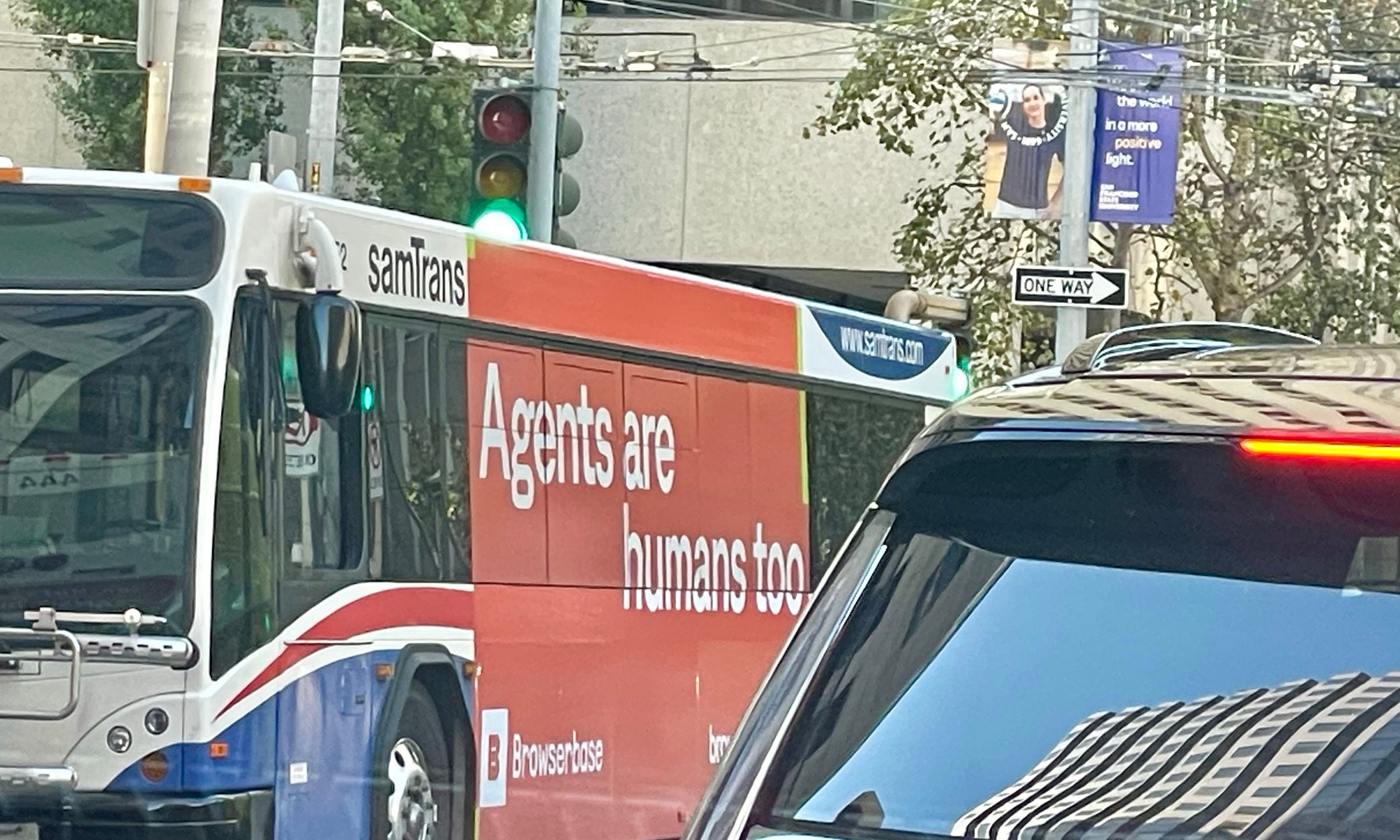
Agents are humans too?
I’ve worked in marketing for a long time, and I get the ad. It’s very clever: agents can do far more complex work when they have access to the same tools and systems that humans do, and it’s incredibly useful when AI can use Chrome to do research or find that software setting buried three layers deep in a bad interface.
Still, the ad made me triple-take, not because of the cleverness, but because, well, it states something that is objectively false. Yes, marketing copy has long made promises that products can’t keep, but these words—Agents are humans too—felt viscerally wrong because they are a blatant denial of fact. Yet here we are.
How did we get here?
When faced with questions like, are agents humans?, it’s helpful to stop and ask why we would need to ask the question in the first place. Conceptually, this isn’t new territory.
AI is designed to feel human
In the 1980s, KITT was the coolest car imaginable, an autonomous digital aid to a human fighting crime. Marvel movies in more recent years have explored J.A.R.V.I.S., Iron Man’s sentient sidekick at home and in battle.
But these were science fiction concepts. Now, anyone with an internet connection can chat with GPT or Claude, and the interaction is so approachable, so familiar to texting with a friend, that we use the same tone with AI that we use with the people we work with and care about.
AI is designed to feel human, so perhaps we shouldn’t be so surprised when we find ourselves thinking about it and treating it like one.
AI is powerful
But it’s not just that AI seems human when we talk to it. AI is useful. It is powerful. It is now capable of automating entire parts of people’s jobs, which is why people have used the terms intern, employee, and personal assistant to describe it.
If AI can take over human work, it’s natural for us to imbue it with human qualities. But should we?
Mind the power, and your perception
The tools we use, personally and professionally, shape us, for better or worse. The determining factor is how we perceive them.
Out of the box, AI feels human. And it feels powerful, because it is. But over time, if you let yourself view AI as a human, even sub-consciously, you’ll imbue it with qualities it fundamentally doesn’t have, and begin to set unrealistic expectations for real humans.
Real people aren’t always agreeable, haven’t stored the internet in their brain, and can’t work 24/7, but they are fundamentally creative (not just generative), and as hard as relationships are, they are core to our well being, at work and at home.
We have limited control over how human AI feels, but we can control how we view it and use it. It’s up to you to remind yourself it’s a machine, while still learning to harness its power to amplify your craft.
Watch or listen
You can watch or listen to the conversation that inspired this newsletter. Watch the video below, or check out the audio on Spotify or Apple Podcasts.